
Love County Projected Versus Actual Release
A projected date is an estimate tied to a sentence calculation or a parole-docket record. Oklahoma uses more than one label. The Pardon and Parole Board's legacy docket has a field called “Projected Release Date.” ODOC describes its inmate calculation as tentative and generally confidential. The agency says the calculated date can move. The public ODOC lookup should not be promised as an exact release-date display because the research did not verify a released-person screen with a public discharge date.
Actual release is the event when the facility carries out the lawful discharge or transfer. The maintaining jail or prison record is the best proof. A court order supplies authority but can precede processing. A parole result records a decision stage but can precede more checks. A VINE notice reflects a source agency's report. Each is useful, yet none should replace the actual Love County jail discharge entry or ODOC custody record.
- Projected date
- An estimate or docket milestone based on information available when the record was made.
- Tentative calculation
- ODOC's changeable sentence calculation, affected by credits, conduct, court action, and other rules.
- Actual release
- The documented physical discharge or transfer carried out by the holding agency.
- Detainer
- A hold or request from another authority that can change the destination without changing the first agency's exit date.
Love County Release Date by Custody
Identify the current legal setting before searching for a date. A Love County pretrial detainee is being held while the case proceeds. Bond, dismissal, a court order, another hold, or later sentence can change custody, so there may be no fixed release date. A person serving a county-only sentence has a judgment and jail credits, but no Love County county-good-time or weekend-release rule was found. Do not import ODOC credit tables into that county calculation.
A Love County defendant committed to ODOC has crossed into state custody. That county-roster disappearance is a transfer, not a community release. ODOC then administers the sentence. A federal term belongs to the Bureau of Prisons, and an immigration handoff belongs to ICE. Those federal systems cannot be used to calculate an Oklahoma county or state release date.
| Custody setting | Best date source | Main limit |
|---|---|---|
| Love County pretrial | ODCR court events plus the jail's actual discharge entry | No fixed date while bond, court action, and holds remain open |
| Love County sentence | Judgment, documented jail credit, and sheriff discharge record | No verified county good-time or weekend rule |
| ODOC sentence | ODOC status and records; PPB docket when parole applies | Public lookup does not promise an exact release date |
| Federal or ICE | BOP, ICE, actual detaining agency, and federal docket | Separate sovereign and separate calculation |
Note: Leaving the Love County jail can mean transfer, so identify the receiving authority before calling the event a release home.
Find a Love County Projected Date
Use the person's number whenever possible. Similar names can produce a false match. Save each search time and copy the status label without changing its meaning. The ODOC Offender Lookup can establish whether the person is in the state system and provide abbreviated correctional information. ODOC warns that the result may not be complete and has noted migration issues in its public data.
- Check the Love County current roster only to rule in current county custody. Absence does not prove release.
- Open the Love County case at ODCR. Read the judgment, jail credit, sentence structure, revocation entries, and later court orders.
- For an ODOC commitment, match the person in the state lookup by ODOC number or exact name and chronology.
- If parole applies, use the PPB docket and meeting records. Read the projected field, authority percentage, detainers, action, and conditions together.
- Ask the current jail or ODOC for its existing calculation, status, or discharge record when the public sources do not resolve the question.
- After the date passes, confirm the actual event instead of assuming the projection occurred.
The ODOC search form is a public status starting point:
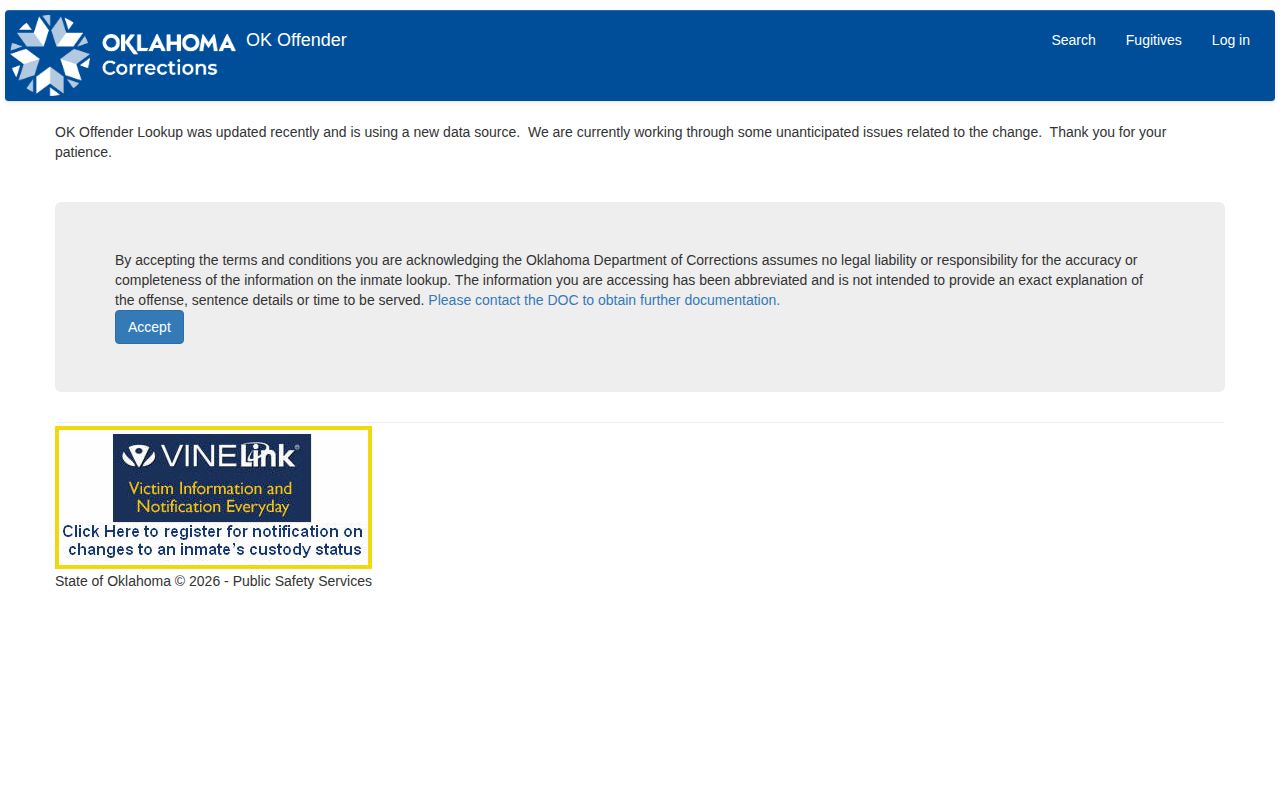
Its public result must be transcribed as displayed and should not be described as a guaranteed exact release-date source.
Love County PPB Projected Date
The verified public interface with the exact field “Projected Release Date” is the PPB legacy docket search. It is reached from the Board's docket-search resources and is built around a docket month and year. Optional fields include DOC number, last name, and county, including Love. The result can display identity and DOC number, appearance type, offense and county, authority percentage, last and next consideration, reception date, sentence structure, detainers, decision action, conditions, and the projected date.
That depth makes the docket useful, but it also shows why the projected field cannot stand alone. A detainer, consecutive case, later consideration, condition, or non-release decision may appear beside it. The legacy year selector ended at 2025 when researched, so current meeting documents should be checked through the PPB meeting hub. A docket is a parole record, not an ODOC discharge certificate.
The captured PPB docket-search interface shows the fields used to narrow a Love County parole record:
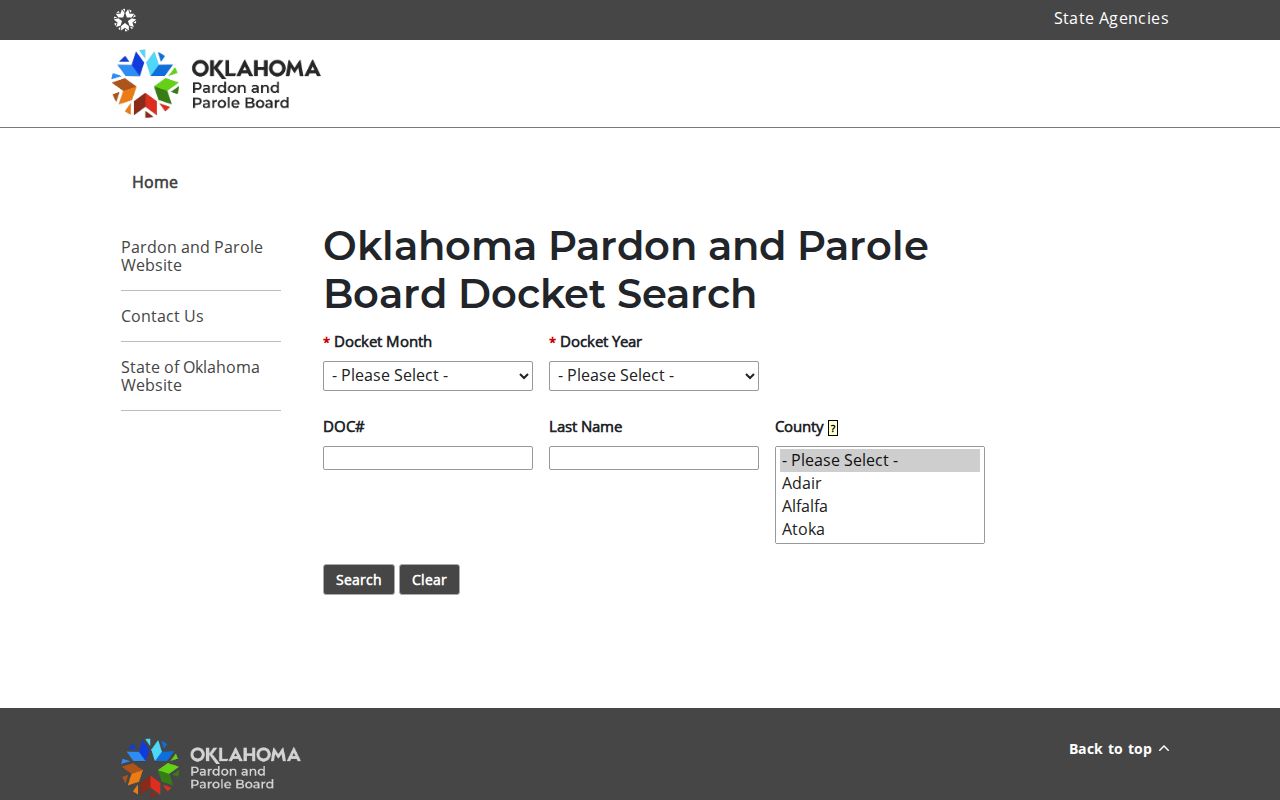
Match the DOC number and docket period first, then read the projected date beside the action, sentence, and detainer details.
Love County State Earned Credits
For an ODOC sentence, Oklahoma's earned-credit law is 57 O.S. §138. Each earned credit reduces incarceration by one day. Prisoners are classified each month. For people ever convicted or adjudicated of a felony listed in subsection E, levels one through four earn zero, 22, 33, and 44 credits per month. For others, the levels earn zero, 22, 45, and 60. Achievement and eligible jail-time credits can also affect the calculation.
The level is not fixed for the whole term. Discipline can remove credits, and agency rules can allow restoration. Misconduct, achievement, classification changes, corrected jail credit, and an audit may move the tentative date. Life sentences and statutory exclusions restrict credit use. The controlling law, judgment, and ODOC calculation matter more than a hand calculation based on a sentence length.
County-only time is different. No Love County policy was located that establishes county good time or an early weekend discharge. Use the actual county judgment and the sheriff's discharge entry. A state credit chart should never be copied onto a Love County jail sentence merely because both are in Oklahoma.
Note: Earned credits apply through the controlling state rules and record, not through a generic sentence-length estimate.
Love County 85 Percent Rule
Oklahoma's 85 percent rule is not universal. 21 O.S. §13.1 lists serious offenses that require at least 85 percent of the sentence before parole eligibility and prevent credits from reducing confinement below that floor. The offense of conviction controls. A booking charge is only an allegation and cannot be used to assign the rule.
Parole eligibility is also not a release date. Under 57 O.S. §332.7, the fraction and timing depend on the offense, offense date, and exclusions. Older or nonviolent cases may use one-third rules, while qualifying nonviolent cases after November 1, 2018 may use one-fourth. Violent and §13.1 cases, other exclusions, and life without parole change or bar those summaries. Eligibility permits consideration; it does not require a favorable decision or physical discharge.
Why Love County Release Dates Change
A release calculation is built from the sentence, credited jail time, concurrent or consecutive structure, statutory restrictions, monthly and achievement credits, credit losses or restoration, and later court action. Concurrent sentences run at the same time to the extent the judgment allows. Consecutive sentences run one after another. A mistaken assumption about that structure can shift an estimate by far more than one monthly credit change.
| Factor | Possible Effect | Record to Check |
|---|---|---|
| Credit level or achievement | Changes the rate of earned days | ODOC calculation and credit history |
| Misconduct or restoration | Removes or restores eligible credit | ODOC disciplinary and sentence records |
| Corrected jail credit | Changes time already counted | Judgment, court order, and ODOC audit |
| Appeal or post-conviction order | Can alter the sentence or authority | ODCR docket and filed order |
| Parole action or commutation | Can create a release path with further steps | PPB result, Governor action when required, and ODOC implementation |
| Detainer or warrant | May change destination or block community return | ODOC record and receiving authority |
A detainer can preserve the projected end of one custody segment while changing where the person goes next. The accurate statement is “released by ODOC to the named authority” when the record supports it. Calling that person released home would hide the continued custody.
Love County Parole Release Cycle
Oklahoma separates a favorable parole stage from the actual gate event. The official PPB FAQ describes prerequisites that follow Board action: certificate signature, verification of a home offer, completion of stipulations, and checks for detainers or warrants. A violent recommendation also requires action by the Governor. Until those steps are complete, the date remains a prospect rather than proof of release.
The same FAQ describes a weekly administrative rhythm. A probable-release list is prepared Monday, facilities respond by Tuesday afternoon, and a final memo follows Wednesday, with weekly release except after a Board meeting. That cycle explains why a docket result and physical release may not share a date. It is not a promise that every Love County person leaves on a set weekday.
Confirm the final event through ODOC or the holding facility. For a pending agency event, an OK VINE alert can provide notice when the source reports a change; the Love County VINELink check explains exact-person matching and registration. A notice still should be compared with the original agency record.
Confirm Love County Actual Release
For an ODOC sentence, request existing status or discharge documentation through ODOC Legal Services. Sentence Administration lists Closed Records at (405) 425-2691 and osordischarges@doc.ok.gov. Provide the ODOC number, a narrow date range, and the specific records sought. Nonpublic personal fields may require a proper authorization form. A public lookup result alone does not answer every sentence or release question.
For a county sentence, ask the Love County Sheriff's Records Division for the maintained jail-register and discharge entry. Pair it with the ODCR judgment and any later order. Do not calculate an early Friday release when no local weekend rule was found. If the court filing and custody record differ, compare their purposes and timestamps before asking the holder to resolve the gap.
The Love County release-record search covers the jail, court, ODOC, and transfer branches. A sound final account identifies the person, holding authority, projected milestone, actual discharge event, and destination. It also keeps supervision end separate. That makes the result useful without turning a changing calculation into a promise.