
Love County Parole Versus Probation
Parole is a conditional release from prison while part of an imprisonment term remains unserved. The Oklahoma Pardon and Parole Board considers parole, but the Oklahoma Department of Corrections, or ODOC, administers the sentence and supervises a person after release. Probation usually comes from a court sentence, often through a suspended sentence under 22 O.S. §991a. It may begin without a state-prison stay. The court sets the judgment, while ODOC may provide supervision. Neither status should be inferred just because a person disappeared from the Love County jail roster.
The practical difference matters. A parole docket can document a recommendation or grant, yet it does not certify that the person left an ODOC facility. A probation order can exist even when the person was never in ODOC custody. For either status, identify the court case and state record, then confirm the assigned office and whether supervision is active, inactive, transferred, revoked, or discharged.
| Point | Parole | Probation |
|---|---|---|
| Basic meaning | Conditional release with part of a prison term left | Court-ordered community supervision, often tied to a suspended sentence |
| Key authority | PPB considers parole; ODOC carries out release and supervision | The sentencing court enters the order; ODOC may supervise |
| Useful records | PPB docket or result, ODOC status, and ODOC discharge record | ODCR court docket, judgment, ODOC status, and supervision record |
| End point | Discharge or other lawful termination of the parole term | Court or agency completion, discharge, revocation, or other case action |
- Discharge
- The formal end of the custody or supervision authority shown in the maintaining agency's record.
- Absconder
- A person alleged to have stopped reporting or otherwise left supervision without authorization.
- Detainer
- A request or hold from another authority that may direct where a person goes after one custody term ends.
Verify Love County Post-Release Supervision
Start with identity, not a broad name match. An ODOC number is the strongest public search key. If it is not known, use the exact name and compare the sentence, county, court chronology, and any other lawful identifiers shown. The ODOC Offender Lookup is an abbreviated public status tool. ODOC warns that it may be incomplete or inaccurate, so it is a lead rather than a final supervision certificate.
- Search the ODOC record by number, then by exact name if needed. Save the status wording and lookup time.
- Open the Love County case through ODCR. Compare the judgment, suspended term, revocation entries, or commitment with the ODOC chronology.
- If parole applies, check the official PPB docket or meeting record. Read the action, conditions, detainers, and dates without treating a vote as physical release.
- Contact the supervision office named in the record. Ask whether it is the correct office and what public active or inactive status can be confirmed.
- For documentary proof, request an existing ODOC status or discharge record from Sentence Administration or Closed Records.
A Love County jail-only stay may produce no ODOC record. In that case, use the county jail register and the court case to determine whether the person left on bond, completed a county term, entered probation, or transferred. The broader Love County released-inmate search path separates those county records from state supervision.
Note: Record the exact agency, status phrase, identifier, and lookup time before drawing a conclusion about supervision.
Love County Parole Decision Records
The Oklahoma Pardon and Parole Board meeting hub posts meeting details, agendas, signed minutes, annual dates, and deadlines. Regular hearings generally occur each month across several days. An individual time can remain unsettled until close to the hearing because a person's facility assignment can change. Older dockets and results are also searchable through the Board's legacy system, while current records should be checked at the meeting hub.
Board actions need careful reading. A nonviolent parole may be granted by the Board, while a violent parole recommendation requires gubernatorial action. Pass, deny, stricken, consecutive-sentence, STREET, DET OR STREET, and DET OR VOID codes describe decision stages or possible destinations. None, standing alone, proves a Love County person walked out of prison. Votes remain tentative through final-day adjournment. Certificate signature, a verified home offer, conditions, and warrant or detainer review can still remain.
The PPB answers process and docket questions at (405) 521-6600. ODOC, not the Board, answers questions about release execution, current custody, sentence administration, and supervision. That split prevents a favorable vote from being mistaken for an actual state discharge.
The official PPB meeting calendar gives the context behind a Love County parole result:
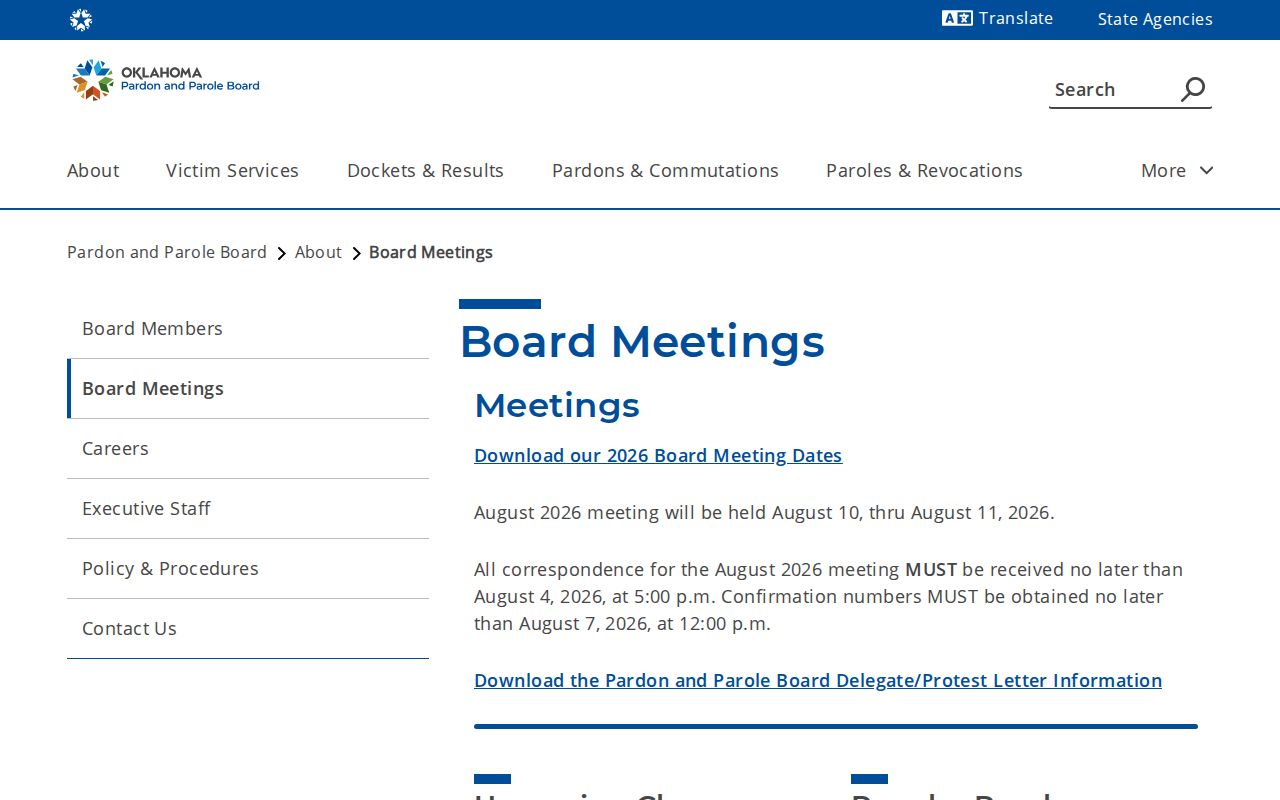
The calendar identifies the meeting record to review, while ODOC remains the source for implementation and current supervision.
Love County Supervision Starts in Ardmore
Love County does not have a separately listed ODOC probation and parole office in the state directory. The ODOC Probation and Parole Services directory lists Ardmore as covering Carter and Love counties. That makes Ardmore the right starting point, not a promise that every Love County case remains assigned there. A move, transferred supervision, residence, special program, or caseload decision can place the record with another office.
ODOC Ardmore Probation and Parole
119 Stanley SW
Ardmore, OK 73401
Phone: (580) 223-6350
Give staff the exact name and ODOC number when available. Ask whether Ardmore is the assigned office and what public confirmation can be supplied. Do not ask for a check-in site, private residence, or case-management detail that is not meant for public release. PPB is the board office; it is not the local check-in office.
Note: Office coverage is a routing aid, and the named person's current ODOC assignment controls.
Love County Absconder and Warrant Status
An absconder or fugitive entry concerns supervision enforcement. It does not show a fresh Love County booking and does not erase the earlier release. ODOC maintains a separate fugitive and warrant path through its offender-information resources. A result should be read with the ODOC identifier and current status. Do not approach the person or try to enforce the warrant.
The ODOC Fugitive Warrants Division lists (405) 425-2570, (405) 425-2571, the toll-free line (866) 363-1119, and warrants@doc.ok.gov. Use those channels for an official warrant or absconder question. If the Love County jail roster also shows the person, the roster reports current local custody and should be timestamped. If it does not, the warrant status alone does not establish where the person is.
Love County Supervision Changes
Conditions are the rules attached to parole or probation. The actual order and supervision record control. Conditions may include reporting and other case-specific duties, but no one should assume a standard set applies to every Love County record. A violation allegation can lead to a warrant, revocation process, detention, a change in terms, or no final adverse finding. The filed court or agency action shows what happened.
Revocation means a court or proper authority withdraws some or all of a community-based term after the required process. Remand means sending a matter or person back to the proper court or custody authority for further action. Neither term should be reduced to a claim that someone is now in the Love County Justice Center. Check the current holder's official system, then compare the ODCR case, ODOC status, and any supervision warrant record.
Love County Registry Is Not Discharge
The Love County Sheriff's local registration page creates a distinct post-release layer for people who have a statutory duty to register. It gives set verification windows and provides a Release/Relocation form. The word “release” in that form concerns registry movement and reporting. It is not the jail's physical discharge record, a parole certificate, or proof that supervision ended.
Registry status applies only to people covered by the governing law. Presence should be reported as a registration duty, not as a recent-release date. Absence says nothing about a person who is not subject to that law. Corrections belong with the maintaining sheriff or ODOC registry unit, while supervision corrections belong with ODOC and the assigned office. Keeping those record types apart avoids turning a local registry appointment into a false claim about custody.
Note: A registry event, court event, and supervision event can occur on different dates and answer different questions.
Confirm Love County Supervision Discharge
Supervision ends only when the controlling term is lawfully completed, discharged, or otherwise terminated. A projected release date, parole vote, inactive office response, or missing public result is not enough. Ask ODOC for the existing status or discharge documentation. Sentence Administration lists Closed Records at (405) 425-2691 and osordischarges@doc.ok.gov through ODOC Legal Services. The request should use the ODOC number, date range, and exact record sought.
Compare that response with the Love County court record. Probation may end by its own court and agency process, while parole completion belongs to the state sentence history. A discharge ends the named supervision authority. It does not rewrite the original case, and it should not be confused with expungement, which is a separate court process affecting public access to qualifying records.
When records conflict, compare timestamps and scope. A Board record covers deliberation. ODOC covers sentence administration. ODCR covers the Love County court case. The jail register covers county custody. A precise conclusion names the authority, the event, and its date instead of using “released” as a catchall.